



 Kennzahlen


 Bilfinger Berger Magazine 2/2008


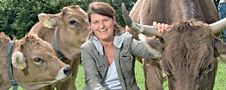

MOST COWS HAVE THEIR HORNS AMPUTATED. NOW SOME FARMERS IN GERMANY’S ALLGÄU REGION ARE REJECTING THIS AGONIZING PROCESS. THEY WANT THEIR BEASTS TO “KEEP THEIR CROWNS.”
Truth be told, Susanne Schwärzler lives an idyllic life. No cause here for complaint. The meadows that surround her farm in Kempten where she lives with her husband, four children and her mother-in-law are grazed by a motley herd of cows, goats, sheep and horses. A rooster stalks across the yard, his hens at heel. The garden fruit trees are alive with the buzzing of bees,wild flowers bloom in the meadows. But when the conversation turns to cattle and the dairy industry, her anger flares. Her wrath is directed towards a method that has been practiced in cowsheds from the Baltic to the Alps since the 1980s. Since the time when an increasing number of farmers ceased chaining cows to the feed trough, switching to loose housing systems instead. An animalfriendly improvement, one might think, were it not for the practice of dehorning, which Susanne Schwärzler describes as the “amputation of an organ.” Because farmers fear that in the close confines of the pens the animals may injure one another, they saw off the cows’ horns. An agonizing procedure given that the horns are well supplied with blood and sensitive to pain. Full-grown beasts must be drugged by a vet before the horns are removed with a rope saw. In the case of calves, they don’t bother with the anesthetic and instead burn off the buds in the first six weeks of life so the horns can no longer grow—methods that are opposed by the “Horned Cows Action Committee,” of which Susanne Schwärzler is the spokesperson. She estimates that only one in ten cows in Germany still has horns.The Federal Ministry of Agriculture has no statistics on the subject. Even in organic circles, dehorning is common practice. Only the Demeter Association, where Susanne Schwärzler is a member, guarantees that its animals are left as nature intended.
ALL COWS HAVE HORNS
A look in her barn says more about ethical animal husbandry than any declaration of intent. It looks like something out of a child’s storybook. Beneath the wooden beamed ceiling is a large open space divided by timber hurdles in which the cows have plenty of room and deep straw beds, as well as a long stone drinking trough with fresh water from a spring in the yard. Under humane and generous conditions like these, each animal has enough room to move and no reason to behave aggressively towards others. All the cows have horns of course.“The horns are like a crown on the head of the cow,” says Susanne.
They are in fact much more than just decoration.“In places where they can’t reach with their tongues, they scratch with their horns instead,” she explains. The horns also help to regulate temperature—when a cow has a fever, the horns that are otherwise at body heat go cold. The horns even aid digestion.“When a cow chews the cud, gases penetrate via the sinuses into the core of the horns.” The more difficult the feed is to digest, the more majestic the horns. Zebu cattle that live from the tough grasses of the African plains and cows that graze the sparse fields of the Scottish Highlands have large horns. Cattle that eat the easily digestible fodder in the rich marshlands near Germany’s North Sea coast have short shrunken horns.
NATURE DOES NOTHING WITHOUT REASON
Ton Baars, Professor of Biodynamic Agriculture at the University of Kassel in Germany, confirms that such connections exist. He makes no secret of his leanings towards anthroposophy, but his scientific research is based on objectively verifiable criteria: He is currently investigating how organically produced milk differs from the conventional product. His analyses focus not only on horns, but also on the different feeds that the animals consume.“Since March we have been comparing the milk produced on 24 biodynamic and conventional farms between Lake Constance and the Hohenlohe district,” says Baars. Some of the farms studied have cows of the same age with and without horns.The experiment is due to last for a year, during which milk samples will be taken at regular intervals. Susanne Schwärzler believes that milk from cows that have had their horns amputated can contribute to allergies and neurodermatitis in humans. Ton Baars remains cautious: “It is too early to say.” Regardless of the science, for Susanne Schwärzler it is the principle that matters. Quoting the Greek philosopher Aristotle, she notes that “Nature does nothing without a reason. ”Why should cows have horns if they don’t need them? Modern agriculture is aimed solely at maximizing milk yield— “Many farmers are just interested in fitting as many turbo-cows as possible with big udders and no horns into the shed.” Because cows with horns need more space in their stall, ten square meters instead of six.
COWS ARE NOT AGGRESIVE
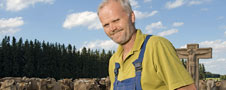
Thomas Dieng, a Demeter farmer near Memmingen, has sixty dairy cows and one bull in loose housing. When he took over the farm 25 years ago, his predecessor had dehorned half the herd. “The ones with horns were on the left, the others on the right. A pitiful sight! They looked like sheep.” He shakes his head. Dieng is a man of few words. He says simply,“Cows have horns and it is not right to cut them off.”So he built a bigger barn and avoided all the congestion at the drinkers, feed troughs and doorways.The animals even have the chance to move about in a pen outside the barn and can also go and lie down in a loosebox, something the lower-ranking cows particularly enjoy. From spring to autumn they are out at pasture all day. Hyperactive beasts in heat are separated from the herd. Injuries hardly ever occur.“Cows generally have a placid temperament,” says Dieng. “They are not naturally aggressive.” But you have to learn how to behave in the pen with them. Especially when there is a bull around. Dieng keeps a constant eye on the huge creature that towers over all of the cows:“The bull is king here.”And naturally the king wears a crown.
Text: Uschi Entenmann, Photos: Eric Vazzoler
Bilfinger Berger Magazine 2/2008


