



 Kennzahlen


 Bilfinger Berger Magazine 2/2008


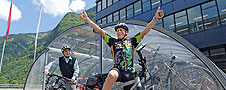
INFICON, A COMPANY IN LIECHTENSTEIN, REWARDS ITS EMPLOYEES FOR DOING WITHOUT THEIR CARS. ONE SIDE EFFECT IS FEWER EMPLOYEES OFF SICK.
The sun has just begun to peep above the mountain tops as Urs Wälchli pedals round the corner. With his briefcase clamped to the luggage carrier and bicycle clips restraining the legs of his beige-colored suit, he’s whistling. “What a beautiful morning,” he remarks. “If I had come by car, I would have missed all this.” Urs Wälchli smoothes his suit and strolls through the glass door into the lobby of a massive industrial building: He is the Managing Director of Inficon in Balzers, a company that manufactures vacuum measuring equipment for the world market. He turns to greet his management colleague Georg Sele who has just locked his bicycle helmet away in the locker.“The Brooks leather saddle is super comfortable,” says Urs Wälchli. “It was well worth buying it.” Managers at other companies may discuss the merits of their luxury sedans—Inficon managers wax lyrical about bicycle saddles.
It all began with some simple arithmetic: “When we were designing our new building, we would have had to provide parking spaces for 75 percent of our employees. That would have meant putting two levels of basement garages beneath the building, a huge investment,”says Georg Sele. Instead he had a better idea:“We encourage our employees to come to work by bicycle or public transport.”No easy task for a company in a rural area, surrounded by mountains. Especially when around 70 percent of the workforce commutes each day from nearby Switzerland. Cycle paths are few and far between. And in Liechtenstein perhaps more than anywhere else, the car remains a status symbol.“Not that people actually spend much time driving their cars,” says Sele. “They tend to sit in the garage or a parking slot for 23 hours out of 24, just quietly costing money.”
BICYCLES PAY DIVIDENDS
Knowing that the easiest way to reach people is via their wallets, Sele came up with a system that substantially benefits those among the 220-strong workforce at the location in Balzers who choose not to come to work by car: They have to pay to use Inficon’s basement parking spaces. An employee who could easily come to work by bicycle or train has to fork over 720 francs a year to park. For anyone facing a journey of over an hour, the charge is reduced by half. Even cleverer are the positive incentives associated with membership of the firm’s own Mobility Club. Those who come to work by bicycle or public transport or a car pool and who undertake not to drive to work on more than twelve days per year are classified as Top Members—and have the sum of 500 francs credited to their account. In addition, all club members enjoy membership in the Mobility CarSharing Switzerland organization and can use the vehicles free of charge on working days—there is always one available directly in front of the company entrance.
Nowadays over half the employees leave their cars at home and profit from the bonus system that rewards them for not driving. But it is Inficon itself that benefits most. “We have one of the lowest sickness rates in Liechtenstein,” says Sele. “I put that down to the stressfree journey to work: Cyclists are healthier people.”
MORNING SAFARI
It was curiosity that drove Heini Eggenberger, Manager of the Repair Department, to switch to a bicycle:“My colleagues were always telling me how refreshing it was, and I just wanted to try it and see.”Since then the morning ride to work has become something of a wildlife safari: “I often see a fox or a heron by the roadside, and sometimes deer leap out across the road.That is heartwarming.”Eggenberger regularly logs his distances in an Excel spreadsheet: In five years he has cycled 33,219 kilometers to and from work.“Can you imagine how much that would have cost by car?” he asks.
Inficon provides showers and towels so the cyclists don’t have to sit at their desk or workbench soaked in sweat. Originally, some 65 percent of the workforce, men and women, used their cars to drive to work. Now the rate has nearly reached the company’s self-imposed 40 percent target. Energy consumption and CO2 emissions have been reduced by a third.“Managing mobility at company level is just that, it’s a management task,” says Georg Sele.“If the management doesn’t take it seriously, no one else will either. “I am not some kind of monk,” says Urs Wälchli. “And I am certainly not a fundamentalist. Sometimes I rent a Porsche just for the fun of it. But when I cycle to work in the morning, I feel like a different person.”In the afternoon he has a meeting with one of Liechtenstein’s banks. So he’ll take the bright red pool car that stands out front. “And I’ll park it right between the Porsches and Mercedes the other clients drive. That always makes my day!”
Text: Philipp Mausshardt, Photos: Franz Killmeyer, Christoph Püschner
Bilfinger Berger Magazine 2/2008


