



 Kennzahlen


 Bilfinger Berger Magazine 1/2009


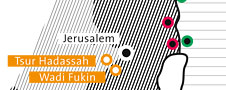
Ever since he can remember, 65-year-old Abu Mazen has grown parsley, lettuce and tomatoes on tiny plots of land. The old farmer’s face is parched by sun from working in the fiery heat of Wadi Fukin, a small valley in the hills of Judea south of Jerusalem. For all his labors, his livelihood is increasingly at risk.
The Holy Land may have flowed with milk and honey in biblical times, but today it is suffering from a severe water shortage. Waterintensive agriculture and millions of households are draining the springs and wells. The Jordan has become a dirty trickle. The river delivers only a tenth of the water it once supplied to the Dead Sea, which is slowly drying out. The Sea of Galilee, the region’s largest reservoir, is at a record low. The groundwater table is sinking.
And yet for a long time Abu Mazen regarded the Israeli settlement of Tsur Hadassah on the hill above the valley as the biggest danger to his fields. Since 2003 the Israelis have been building fences and walls on the border with the West Bank, for fear of attack. There were also plans to construct such a bulwark on the slopes between the Palestinians in Wadi Fukin and the Israelis of Tsur Hadassah, with serious consequences for the Palestinian farmers: The slope serves as a rainwater catchment that feeds the springs in the valley. The barriers with their concrete plinths and gutters would impede the flow of water to the springs and put the farmers’ very existence at risk. “If we want peace,” says Abu Mazen, “then we must not just stop the rockets, but the bulldozers as well.”
COMMITMENT TO CONCILIATION
The Palestinians of Wadi Fukin found allies among the Friends of the Earth Middle East (FoEME), a unique organization in the region with branches in Amman, Bethlehem and Tel Aviv. Despite the tensions between the populations, there are Israelis, Palestinians and Jordanians all working together at FoEME in the interests of ecology — and peace. Because protecting the environment generally requires social consensus, in the Middle East it also entails a commitment to conciliation. In Wadi Fukin, FoEME activists raised a petition against the construction of the barrier fence. They also found supporters in the Israeli village of Tsur Hadassah. They engaged an Israeli lawyer and commissioned a scientific report on the issue of water conservation. And they succeeded: The Israeli military called a halt to the construction plans. For the first time, a section of fence was omitted on grounds of nature conservation. “A lot of Israelis lent us their support,” says Abu Mazen. “That shows that they want one thing above all: peace.”
MEETING AT SUMMER CAMP
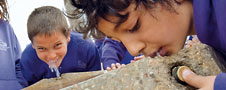
The understanding between the Palestinians of Wadi Fukin and the Israelis of Tsur Hadassah is the result of a broad-based initiative by FoEME entitled “Good Water Neighbors.” The program includes 21 Israeli, Palestinian and Jordanian communities who share cross-border water sources. In every village there is a delegate who lobbies authorities in support of the project and coordinates the activities of the helpers. They build rainwater storage tanks and visit schools to teach the children how to be careful in their use of water. Israeli and Palestinian children even get to meet one another at summer camps. For many, it is their first encounter with children of their own age from the other nation. “The inhabitants of the Israeli and Palestinian villages get to know and understand each other better,” emphasizes Nader Al-Khateeb, one of the three directors of FoEME. He is a Palestinian; the other two directors are an Israeli and a Jordanian.
Tamar Greidinger, a 50-year-old Israeli from Tsur Hadassah, has worked for FoEME for four years. Passing between the young olive trees, she climbs up the eastern slope of Wadi Fukin. On the hill above, opposite Tsur Hadassah, is the rapidly growing Jewish settlement of Beitar Elite. In 2005 the Palestinian farmers in the valley complained that expanding the settlement would deprive them of their terraced fields, as the bulldozers were simply tipping the excavated material down the slope. Tamar Greidinger props herself against a huge rock in one of the fields: “Along with the villagers from Wadi Fukin, I stood in front of the excavators to stop the destruction.” With success: From then on the builders found other ways to dispose of the boulders. “I am concerned as much about human rights as water conservation,” explains the mother of three. “That’s why I support FoEME — even though my husband is against it.”
GREEN SHOOTS OF CONVERGENCE
Her husband’s reaction shows just how tender the green shoots of convergence still are. In Wadi Fukin, too, some inhabitants are op - posed to cooperating with the Israelis. And in Tsur Hadassah, a 40- year-old Israeli on his way to fetch his eight-year-old daughter from primary school remarks: “Of course protecting the environment is important, but my main concern is security. That’s why I’m in favor of building the fence.”
FoEME Director Nader Al-Khateeb knows all about such reservations, but he is still convinced that his organization will succeed in the long term. The problems of water conservation can only be solved through cross-border partnerships. “At any rate, war never produced a drop of clean water,” says Nader Al-Khateeb.
Text: Malte Arnsperger, Photos: Christoph Püschner
Bilfinger Berger Magazin 1/2009


