Bilfinger Berger Logo

Bilfinger BergerBilfinger Berger Magazine 1/2009

Links
IN NORWAY, SPECIALISTS FROM POLAND ARE ASSEMBLING DRILLING RIGS FOR BOTH THE NORTH SEA AND THE CASPIAN SEA. THEY MAKE UP THE LARGEST NON-NORWEGIAN COMMUNITY IN EGERSUND.

The small town of Egersund is just a stone’s throw from the North Atlantic. It was this proximity to the open sea that convinced Norwegian engineering group Aker Solutions more than thirty years ago to locate their oil platform construction facility here. From this location, the huge structures weighing several thousand tons can be towed quickly and safely to their destinations off the coasts of Norway and Britain.

Even before you enter the yard the notices posted at the gates in three languages — Norwegian, English and Polish — hint at the origins of the workforce. There are 30 nationalities represented on site, with the Poles second only to the Norwegians in number. 160 of them are employed by the Norwegian subsidiary of Bilfinger Berger Industrial Services (BIS), Aker Solutions’ most important partner.

THE TEN COMMANDMENTS OF SHIPYARD WORKERS
For Maciej Gierukas the day begins — as it so often does — with a safety meeting. Gierukas, who was born in Poland and grew up in Norway, is the go-between who liaises with the Polish workers. There are twelve workmen sitting in the meeting room, listening patiently to a speech they have heard a dozen times before, but not always heeded: “The safety regulations here are very strict and it is imperative that they are followed. We’re not telling you this for fun, it’s for your own protection. We want you to be as fit and healthy when you go home in the evening as you were when you arrived in the morning.” Maciej Gierukas and a Norwegian-speaking colleague take turns reading out the previous day’s list of deficiencies identified by the safety officers during their inspections: One worker did not have his safety glasses on, another was not properly roped up in his safety harness, a third had thrown a paint pot that was not quite empty into the garbage container. Trivial things, really, “but it is very often trivialities that make construction sites dangerous — not just in Norway,” Gierukas sternly remarks. He brings the PowerPoint presentation up on the screen with the “ten commandments” of the construction site. “Thou shalt not work without gloves. Thou shalt wear a mask when painting. Thou shalt...” Through the window of the meeting room you can see the huge red assembly shop, big enough to swallow the Reichstag in Berlin. On the other side of the yard two steel structures soar into the sky, wrapped in white plastic sheet ing and looking as if the environmental artist Christo had recently dropped by. “Protects against wind and weather,” Gierukas explains. In a few weeks, the larger module will be delivered to a drilling platform in Norway. The smaller one, still the size of a medium-sized apartment building, will pump oil from beneath the bed of the Caspian Sea one day.

HEAVY PROTECTIVE SUITS
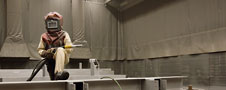
The scene behind the white sheets is like something from the world of science fiction: Workers in protective suits are aiming what looks like a flamethrower at a steel beam that emits a silvery gleam. They are spraying the steel components with an aluminum-zinc alloy that gushes out at high temperature with a speed of 600 kilometers per hour. Two stories higher up, men are getting a future gas holder ready for painting. They too are equipped with thick protective suits, clutching a sandblaster that is stripping the last specks of rust from the bare steel with an ear-splitting roar.

FROM EGERSUND TO KAZAKHSTAN
In Egersund, an important Norwegian fishing port, the air smells of more than just fish. Egersund is also redolent of hope. Each new rig means more breathing space for mankind in his quest for energy. Most of the oil discovered in recent years has been offshore, beneath the seabed. Building these drilling rigs is the core business of Aker Solutions here in Egersund. For years, Bilfinger Berger Industrial Services has been a part of the process, putting up the scaffolding to erect the modules and also assuming responsibility for corrosion-proofing the new platforms that will have to survive decades in salt water.

Until a few years ago, the Egersund yards built platforms only for the North Sea. There are currently around 160 of these offshore rigs operating off the coasts of Norway and Britain. Then the situation changed abruptly with the arrival of an order from Kazakhstan four years ago. In the year 2000, geologists working in the north of the Caspian Sea discovered one of the largest reservoirs found thus far — the Kashagan oil field. It is estimated to hold around 40 billion barrels of crude oil, ranking right up there with the big fields of the Middle East. Starting in 2011, an international consortium headed by Italian oil conglomerate ENI intends to pump up to 1.5 million barrels of oil a day from beneath the seabed. Aker Solutions was given the order to build modules for the rigs.

But when Aker started looking for employees for its major project, it quickly became clear that not too many Norwegians would be willing to make the trip to remote Egersund. Then Bilfinger Berger offered the assistance of its Polish subsidiaries. The order situation in Poland was slack, but the company wanted to retain its well-trained workers. So they were offered the chance to go temporarily to Norway, where wages are almost twice as high as back home. The decision wasn’t hard to make.

SOME WANT TO STAY A LONG TIME
Martin Andres climbs down from the staging he is working on when Maciej Gierukas calls him over. He and a colleague are spraying a twenty-meter tall Kashagan module with protective paint. Gierukas’ roaming eyes check that safety regulations are being complied with: harnesses secure, protective masks in place, both men wearing gloves. Andres doesn’t really have time to spare. Every minute counts. But then he drops into conversation. Andres has been working in Egersund for two years, and he is one of the Poles who intends to remain in the town for a while, if not forever. He has now brought his family to stay with him. Andres is an exception: The majority of his colleagues are rarely spotted around town. They work in the yard and sleep in their camp, and when they are not either working or sleeping, they fly back to Poland every four weeks from the nearby airport in Stavanger to spend a fortnight with their families. These are modern migrant workers earning good wages with a Miles&More card in their wallets to collect bonus miles with all the flying they do.

DEMOCRACY, NOT HIERARCHY
Peter Matthiasen, Project Director at BIS Norway, knows how valuable the highly qualified teams from the Polish BIS sister companies are: “We profit from their expertise,” he says. And he freely admits that the Norwegian and Polish business units will ocassionally compete over a good worker. It was Matthiasen together with Odd-Bjørnar Heiland, his project manager in Egersund, who paved the way for the skilled workers from Poland to be deployed. A general introduction to the Norwegian way of life was high on the agenda. It differs in one respect in particular, maintains Heiland, who sometimes can be found smoking hand-rolled cigarettes with his men during breaks. Whereas the Poles expect precise instructions handed down by their foremen, in Norway the hierarchies are flatter: Everyone has something to say. “Work here is a democratic process,” explains Heiland, “but that’s something you first have to learn.”

It is this feeling of being taken seriously that has persuaded Martin Andres to commit himself wholeheartedly to Norway. His employer even helped him to find somewhere to live. After some searching, Maciej Gierukas found a pleasant, pastel green timber cottage for the Andres family, not far from the town center. At the moment, the furniture still belongs to the landlord, but Martin and his wife Katarzyna are already thinking about where two-year-old daughter Susanna will one day go to school. “We miss grandma,” says Martin, “but then again we think the future here holds much better opportunities for our little girl.”

HOMESICK IN FISHERMAN’S HEAVEN
His colleague Jerzy Domanski, on the other hand, has no plans to stay. “Come in,” he says, “this is my room.” His six square meters of space in the camp near the yard is just enough for a desk and chair, a bed and a cupboard. Jerzy seems tired on this Saturday evening; he has spent all day sandblasting steel beams. Inside his protective suit it was hot and sticky. Beneath the windowsill is Jerzy’s laptop. He wants to spend a while “skyping” with his son in Poland. Tomorrow he will put on his Sunday best and drive into Egersund: The Polish priest from Stavanger is celebrating Mass in the church. Afterwards he will fetch his rod and sit beside the glassy waters of the fjord. He is 1,500 kilometers away from home. “I’ll just look at the water and feel a lit - tle homesick — but I’m actually very happy here.”

Text: Philipp Mausshardt, Photos: Christoph Püschner
Bilfinger Berger Magazine 1/2009