



 Kennzahlen

 Bilfinger Berger Magazine 2/2008



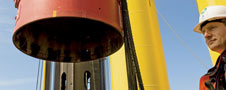
40 KILOMETERS OFF THE COAST OF DENMARK, BILFINGER BERGER HAS CALLED IN GIANT MACHINES TO BUILD THE FOUNDATIONS FOR THE 91 WIND TURBINES THAT COMPRISE HORNS REV 2—THE WORLD’S LARGEST OFFSHORE WIND FARM. NEVER BEFORE HAVE WIND TURBINES BEEN ERECTED SO FAR FROM DRY LAND.
Fifty years have passed since toy maker Godtfred Kirk Christiansen appeared at the Patent Office in Copenhagen. He had just invented some new building blocks made of rigid plastic, with knobs on top and holes on the bottom.With this plug-in system, the blocks could be used to build an endless variety of sturdy towers and machines. Since then the little blocks have conquered the world, with every one of us statistically owning 64 of them. Christiansen called his firm Lego, a play on the Danish phrase “Leg godt!”, which translates as “Play well!”
The structure rising from the water off the west coast of Denmark looks as if it had been designed by a child Lego-building champion with a vivid imagination: The “Sea Jack” is a rectangular platform the size of a football field with steel legs on each corner. The legs can be raised or lowered using steel cables and winches, allowing the platform to lift itself up out of the shallow water. Eight-by-eight meter steel plates form the feet on which the legs stand, and these sink up to two meters into the soft seabed before the Sea Jack finds a footing firm enough to raise itself out of the water. The whole thing is designed with technical practicality in mind. It is also colorful. In the center is a rotating crane with a green superstructure and a blue jib. Its cables creak as it picks up sections of bright yellow and rust-red pipe that are bigger than some of the church towers in the villages onshore. Against all this gigantic equipment, the workers in their orange suits look like ants.
UNIQUE EQUIPMENT
“It’s every boy’s dream to work with machines this big,” says 29-year old Stefan Eckelmann, Bilfinger Berger’s site manager. Did he play with Lego as a child? “Of course I did.” The fascination never wore off: “Designing, building, coming up with technical solutions, it’s just so much fun!” But that’s where the childhood comparison ends. “With Lego you can put the pieces back in the box when something goes wrong.Whereas on this site, even small errors can cost millions.” Some of the special equipment they are using is unique, the only machines of their kind. “If they were to break down, they would be next to impossible to replace.” Like the rotating shoe into which the crane lifts the horizontally stacked foundation tubes. It was designed specifically for this task: Once the tube is lodged in the shoe, the crane can pick up the other end and safely raise it to a vertical position. The engine roars and the steel cables groan as the crane up-ends a pile, positions it in the ram guide—a giant pincer—then lowers it into the water.
When the pincer lets go, the pile staggers under the force of the waves. A surveyor uses sophisticated equipment to check the alignment of the pile, and a few fine adjustments are made. In this broad expanse of water, the men from Bilfinger Berger must locate the positions determined for the foundations by the design engineers and geologists within one meter. Usually they hit the spot within ten centimeters— a degree of accuracy that is incredible to a layman. How is that possible with the Sea Jack that has no engines, a helpless raft that has to be pulled by a tug? The answer should appeal to Lego builders: Using anchors attached to all four corners, the jack-up barge can position itself with astonishing precision. Before each pile is sunk, tugs carry the four anchors half a kilometer away from the platform and drop them.Then with the aid of the anchor winches and a satellite positioning system, the helmsman maneuvers the Sea Jack into exactly the right spot.
AN EFFECTIVE TEAM
Once the surveyor is satisfied with the position of the pile, the crane fetches the hammer.This 14-meter tall monster weighs in at 223 tons— about as much as 120 Mercedes S-Class sedans. The hammer is suspended from the crane hook on cables as thick as a man’s thigh. Despite being made of plastic fibers, the cables are so heavy that it takes two men to lift the loops into place.
The crane operator sets the €5 million hammer down on top of the pile and immediately the tube settles into the soft upper layer of the seabed. “There are only a handful of giant hammers like this in the world,”says Stefan Eckelmann, pressing plugs into his ears. Instinctively the men on deck screw up their eyes in anticipation of the first blow. Boom! The impact drives the pile a good meter into the ground. More impacts follow at two-second intervals. The ram inside the enclosed hammer housing is hydraulically accelerated, slamming into the pipe with a force of up to 120 tons. Site Manager Stefan Eckelmann points to the tug lying a few hundred meters from the Sea Jack and shouts: “Even over there they can still feel the blows of the ram. The boat shivers with the vibrations it sends through the water.”
Once the foundation tube is set about 20 meters deep in the seabed, the crane places a bright yellow transition piece (TP) over the top that projects out of the water like a tower. Its four layers of paint are designed to protect it for decades from the wind- and water-borne salt. The transition piece is then capped with a reinforced concrete maintenance platform. Later it will support the wind turbine tower.The yellow TPs, along with the foundation tubes, were manufactured in the Danish city of Aalborg.They are all welded together using simple components. The steelworkers in Aalborg use powerful equipment capable of bending two- to three-meter wide and ten-centimeter thick plates into rings with a force that makes them seem like cardboard. The 16-ton rings called “cans” look like giant versions of their namesakes, without top or bottom. Between eleven and 15 cans are welded together to form the foundation tubes. Six cans make up a TP.
KEEPING AN EYE ON THE WAVES
A few moments ago the offshore construction was bathed in sunshine. Now the sky is darkening from the west and the sea is the color of slate. It looks like a storm. Out at sea the wind can pick up from one minute to the next. Stefan Eckelmann keeps checking the data coming in from a Dutch weather station, comparing the information with that from a Danish station. Then he confers with the captain and the crane operator. “Despite the time pressure, we frequently have to stop work.” If the wind is too strong, it is no longer safe to maneuver the transition pieces.
With the yellow TP in place, the site manager turns a critical eye to the waves: “If it’s rough, the pile moves just a little, and that could affect the next stage of the operation.” Using hydraulic jacks the workmen position the yellow transition piece so that it is exactly perpendicular, then they fill the gap between the pile and the TP with special mortar: 18 tons of high-strength concrete bind the two parts of the foundation together for all eternity.
Provided the weather cooperates, the teams can place four complete foundations in two and a half days, working two shifts around the clock. Then the Sea Jack has to be towed into the harbor at Esbjerg by a straining tugboat to replenish its supplies: New foundations are hauled around the northern tip of Denmark on pontoons for the Sea Jack to collect. It takes about eight hours for the heavy jack-up barge to make the sixty kilometer journey into harbor.
The speedboat that regularly shuttles out to the site carrying personnel and equipment takes just an hour and a half. Every two weeks it brings a replacement crew to take over from Stefan Eckelmann and his shift. After two weeks without a break, the men look forward to a fortnight with their families. Powered by twin jet propulsion engines, the boat tears towards the coast at fifty kilometers per hour. The yellow steel towers project some 13 meters above the water, but in a matter of minutes they look no larger than toys. Eckelmann’s shift has been working out at sea for two weeks. Now the world takes on a different perspective: However big and heavy the machines and material may be, against this panorama of sky and sea they appear tiny.
Text: Bernd Hauser, Photos: Rainer Kwiotek
Bilfinger Berger Magazine 2/2008


