



 Kennzahlen

 Bilfinger Berger Magazine 2/2008


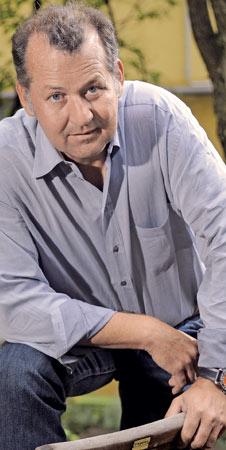
ARCHITECT STEFAN BEHNISCH, 51, CALLS FOR A MORE INTELLIGENT USE OF RESOURCES.
Your father Günter Behnisch designed the Olympic Stadium in Munich which now stands as a symbol of light and airy “democratic” architecture. What do you stand for?
For much the same, but also for new aspects such as sustainability.
What do you mean, exactly?
It is an age-old subject, even Francis of Assisi in his Canticle of the Sun voiced the idea that mankind should show respect for creation. By the same token, we should be actively addressing the issue of making prudent use of natural resources in today’s world.
That is what the Greens were preaching in the 1980s…
They sat in the State Parliament in Hesse, doing their knitting and getting on people’s nerves. But it is for the most part thanks to them that there is an awareness of these issues nowadays.
What did you do, instead of knitting?
In those days I was studying philosophy with the Jesuits in Munich and I became interested in our society’s problems and the challenges facing the Third World. What triggered my interest was the report on “Limits to Growth” by the Club of Rome. Ever since the energy crisis of the 1970s, we have fundamentally been aware that the very basis of our lives is at risk. It became clear to me that we need to find a different way of using resources.
What does that mean for your work?
A great deal has been achieved by small firms of architects drawing on their idealism to design houses that consume a minimum of energy. Our office has profited from their pioneering work. In 1994 we built the Institute for Forestry and Nature Research in Wageningen, Holland, which was a European pilot project that focused on people-friendly, energy-saving construction.
What form did the concept take?
The institute building is flexible, it can grow over the course of its life to meet the needs of the owners. The internal infrastructure can be extended in all directions. If, for whatever reason, there is a need to trim back the building, we are working with reusable materials such as wood, or even pre-cast concrete. We cooperated with the Fraunhofer-Gesellschaft to develop what at the time was the first concept to consider the life cycle of a building.
Did the issue of energy feature in your designs?
An average bank building in Frankfurt consumes between 400 and 800 kilowatt hours of electricity per square meter in the course of a year. Our building in Wageningen consumes just 120. We laid out large, shaded solariums with ponds in them. In summer the wind sweeps through and fans cool air into the interior of the building.
After that you won the contest to design the headquarters of biotech firm Genzyme in the US. Why were you successful?
Because we wanted to build something that was not just environmentally friendly, but something that would promote interaction. The staff at Genzyme work in natural light, they can open windows, hear running water and be surrounded by plants. Even the meeting room furniture is loosely arranged in conservatories. The whole thing is laid out like a small town with public squares and private gardens.
Nice for the employees, but what does the company get out of it?
In studies Genzyme has proven that productivity is up, absences due to illness are down and people are talking to each other again. Besides, companies that build in this way also save on operating costs. Thirty percent of global electricity output is used for lighting! So we create rooms with a large proportion of natural lighting. The building is heated and cooled via the cooling circuit at a nearby power plant.
Are the Americans open to your mission?
Yes, more and more so. We are currently building a 120,000 square meter science center for Harvard University.We won the contest mainly because of our sustainability concept. We are achieving a 50 percent reduction in CO2 , relative to conventional research facilities in the USA.
How do you manage that?
By having different climate zones in differing areas, for example. It doesn’t need to be as cool in the cafeteria or in the corridors as it does in the laboratories.We use integral cooling, sun shading, triple glazing,natural light diffusers, heat recovery, and so on. The science center is an ambitious project: four buildings connected by bridges. Construction began in spring this year and is due to be completed in 2011.
A model for every new building?
It’s a start; we are at the beginning of a new development. But it is not only new buildings.We also have to take a different approach to existing buildings. Instead of tearing them down, they can be reused. Concrete for example is a fantastic material, it can balance out fluctuating temperatures and it is ideal for integral activation. That means the building can be heated or cooled by passing hot or cold water through the framework of the building itself. Concrete is expensive to demolish. So I build on it, use what is already available, rather than crush it and start again.
Of all things, we ought to save the old concrete blocks?
I mean the framework, the structural core of a building. One should at least consider saving them on a case by case basis. After all, the underlying concrete structure represents 25 percent of the cost and 50 percent of the energy I need to build an entire building.
Sometimes you sound as though you are preaching environmentalism.
Maybe, but I’m not bothered by that. The supply of raw materials is becoming tight and global warming is increasing. There is no time left to ignore the problems that we and, above all, future generations will have to deal with.
Interview: Uschi Entenmann, Photo: Eric Vazzoler
Bilfinger Berger Magazine 2/2008


