



 Kennzahlen

 Bilfinger Berger Magazine 2/2008


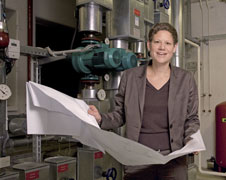
DR. KATI HERZOG IS AN ENGINEER AT BILFINGER BERGER BUILDING. SUSTAINABILITY IS HER SPECIALITY.
Civil Engineer Kati Herzog’s doctoral thesis begins with a quotation from Antoine de Saint-Exupéry: “One cannot see into the future, but one can lay the foundation for things to come—for the future is something one can build.”The following 284 pages devoted to the “Life cycle costs of buildings” are given over to hard facts, some of which are surprising: Around 80 percent of the costs associated with a building are incurred only after it comes into use—maintenance, cleaning, water and sewage, electricity and heating. Designing a structure as cheaply as possible without considering these future costs is therefore a “suboptimal solution,”Kati Herzog concludes with the cool detachment of her profession.
TENANTS WANT ENERGY EFFICIENCY
To put it more plainly, designing a building without considering the resources consumed when it is in use borders on criminal waste. Not just in the opinion of legislators who are laying down ever stricter environmental and energy conservation standards, but in the eyes of the market:“According to a survey by a US trade journal, 80 percent of real estate companies regard energy efficiency as the number one factor in choosing a property,” says Kati Herzog. Private owners and tenants are also becoming much more aware: “Properties that guzzle energy and pour out CO2 will be hard to rent in the future or may even be unsellable.” 33-year-old Kati Herzog describes herself as a sustainability engineer. At the Building Technology Center in Frankfurt where Bilfinger Berger’s construction specialists are based, she and her team of three young engineers are responsible for energy efficiency and sustainable building design.“We work very closely with the other units at the Center including our colleagues in building physics, facade engineers and of course the technical building equipment specialists,” Kati Herzog explains. When a joint project is being developed, each unit initially works out an optimum solution for its special field. Kati Herzog’s task is to bring these solutions together from an interdisciplinary standpoint in order to arrive at the most efficient package— a process that commonly calls for compromises between the various aspects of sustainability.
SUSTAINABILITY REQUIRES COORDINATION
Social sustainability requires that people feel comfortable in a building, which includes the ability to regulate room temperatures for themselves. “But when employees turn the temperature in their office up to 30 degrees Celsius, that ceases to be consistent with either economic or ecological sustainability.” So what is needed is a heating system that supports a compromise between the two scenarios, for example with a thermostat that allows users to vary the room temperature at least by a few degrees from the standard setting.
The earlier differing aspects of sustainability are merged in the design process, the better the advice that can be offered to the client, says Kati Herzog. One piece of advice may be to avoid facades thatmay look attractive but make it expensive to air condition the building.“We prepare model calculations for our customers to illustrate the relationship between investment and operating costs and factors such as comfort and aesthetics,” Kati explains, “in varying combinations and over the entire life cycle of the property.”
The value of designs that are based on sustainability is illustrated by the new regional administration building in Hanover. “Activating” the concrete elements of this office building, which houses around 300 employees, ensures a comfortable work climate in both summer and winter:Water passing through pipes in the ceilings efficiently heats or cools the concrete as necessary. Two probes drilled 70 meters deep in the interior courtyard tap into geothermal energy, while the stateof- the-art insulation and high-quality windows minimize the heating costs. The new building is saving the Hanover regional authority €350,000 per year in energy and maintenance costs.
INTEREST IN GREEN BUILDINGS IS GROWING
Both in building construction and in its public private partnerships, Bilfinger Berger has been concerned with the issue of sustainability for years: Properties are viewed from a life cycle perspective, with operating costs taken into account at the design stage. Increasingly strict environmental regulations, rising energy costs and new sustainability certificates mean that real estate companies and private developers are also beginning to take a more comprehensive view. There is therefore an increasing demand for Kati Herzog’s expertise. At Expo Real in Munich in October 2008, one of the world’s largest real estate trade fairs, she spent two days fielding questions on the meaning and purpose of sustainable building. “We must move towards solutions that make sense in the medium and long term,” she patiently repeats, “and away from short-term thinking.”—Saint-Exupéry again: “When one plants an oak tree, one should not harbor the hope of soon resting in its shadow.”
Text: Bernd Hauser, Photo: Karsten Schöne
Bilfinger Berger Magazine 2/2008


