



 Kennzahlen

 Bilfinger Berger Magazine 2/2008


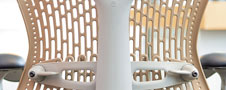
Its name is Mirra, and its mission is to provide comfort all over the world. Mirra sales will soon pass the million mark. The people seated on it include thousands of guests at the Hilton Garden Inn hotel chain, the Bank of Australia and Britain’s Secret Service. Ecologically, they are all sitting pretty—despite the fact that the philosophy behind the chair is concerned not with reducing or avoiding the use of resources, but with avidly expending them. The chair is the brainchild of the designers at Studio 7.5 located in a shady Berlin courtyard. In what was once a machine shop, Carola Zwick, her brother Roland Zwick, Claudia Plikat and Burkhard Schmitz have set up a workshop of their own where they can get on with their welding, grinding, filing, hammering and sawing. It was primarily here that the Mirra was created, rather than on the computer screens on the first floor.
A PROTOTYPE MADE OF SCRAP WOOD AND FOAM
It was about ten years ago that Studio 7.5 received a call from American furniture manufacturer Herman Miller. The company was asking four design firms to put down on paper their vision of the office chair of the future.They wanted lots of big, colorful sketches. Burkhard Schmitz flew to the States with no drawings in his pocket. Instead his baggage contained the prototype for a chair that he and his colleagues had assembled in their little workshop, using scrap wood, steel and insulating foam. The Miller managers sat on it, were impressed, and instructed Studio 7.5 to carry on.What they wanted was a comfortable chair in the mid-price segment at around €800. They wanted it to be environmentally friendly, too.
It was five long years before the chair was finished. During this time the Berlin designers developed seven generations of Mirra, each of which was produced in small lots of one or two hundred and tested for months in offices and call centers. In New York, Chicago and Los Angeles the four designers sat behind mirrored glass, watching as people tried out the chairs. They studied videos of office workers sitting down. Miller even provided them with a report to which not only numerous American industrial companies, but also the US Air Force had contributed, surveying the precise body measurements of around 2,400 people, measured as accurately as possible using lasers.
While the Mirra designers were developing the chair, Miller brought another German expert on board: 50-year-old Michael Braungart, a chemist and Professor of Process Engineering at the University of Lüneburg. Above all else, Braungart is an eco-visionary. He has come up with green ideas for many major companies such as Ford, Nike, and of course Herman Miller. Once upon a time Braungart was a Greenpeace activist climbing chimneys. Nowadays he expounds views that both environmentalists and industrial managers can identify with.
That is because on the one hand he is a radical exponent of environmental protection, while on the other he is also strongly in favor of hardworking productivity. Going without, saving resources, developing a new generation of filters, is not Braungart’s idea of the future. He believes that this will only slow down the destruction of the environment. What the world really needs is the next industrial revolution.
WASTE IS ALLOWED
When Braungart the chemist explains his philosophy, he continually uses nature as an example:“Trees covered in blossom in the springtime look utterly extravagant, because only a very few blooms will produce new trees. But all of the blooms that are not used in reproduction fall to the ground and become nutrients for other organisms—an utterly practical extravagance.”Why shouldn’t human beings manage their production in the same way? Braungart’s message is that waste is allowed if what we waste becomes food for something else. For example, Braungart has developed a T-shirt for textile manufacturer Trigema that can be composted.
In Braungart’s system, anything that doesn’t decay and so find its way back into the ecological cycle is simply reused. Or to cite another example, the more often and more easily a piece of plastic can be recycled without loss of quality, the better. He proposes that when we buy sneakers, a TV or a car, we should no longer be buying the product itself but simply the “service” it represents. The material remains the property of the manufacturer. When the product has done its duty, the maker takes it back, dismantles it into its component parts and reassembles them into new products.
Braungart envisages a world without landfills and environmental pollution in which all consumer goods are manufactured exclusively from non-toxic substances and are constantly recycled.Then no one need have a bad conscience because consumption benefits both man and nature. “Avoiding, reducing and saving for the sake of the environment would be just a distant memory,”Braungart enthuses. He describes this as his “cradle to cradle“ philosophy.
GOING FROM CRADLE TO CRADLE
Mirra demonstrates how the cradle to cradle principle works: The chair is produced using energy from exclusively eco-friendly sources and 96 percent of the material is recyclable, with 42 percent reusable for another chair. The plastic that Miller uses for the chair back can be reused 25 times. It is cheap and requires no particularly complex recipe.The chair can also be dismantled in a matter of minutes—an essential precondition for recycling. The Studio 7.5 designers regard the cradle philosophy as simply revolutionary.“Going without is worthy enough, but sooner or later it leads to bingeing,”says Schmitz.“The object must be for us to continue to live as we have always done, but at the same time not spoil the environment.” Meanwhile there is even a “cradle to cradle” certificate which companies can apply for to highlight their products. No sooner has the principle begun to establish a popular following, than actor Brad Pitt has taken an interest. Together with a cosmetics firm, he has launched his own “cradle to cradle” brand.
Text: Asmus Hess, Photos: Anneke Hymmen, Rainer Kwiotek, Barbara von Woellwarth
Bilfinger Berger Magazine 2/2008


