



 Kennzahlen

 Bilfinger Berger Magazine 2/2008


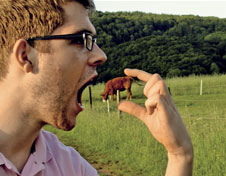
MEATING ENVIRONMENTAL GOALS
According to the UN Food and Agriculture Agency, almost a fifth of greenhouse gases are attributable to cattle production. The world cow population amounts to 1.5 billion. Cows also contribute to food shortages. It takes between seven and 16 kilos of grain to produce one kilo of meat.“The best solution would be for us all to become vegetarians,” says Yvo de Boer, Executive Secretary of the UN Framework Convention on Climate Change. Another reason to give up meat: for the sake of the climate. “I think the proportion of climate-vegetarians is still pretty small,” says Thomas Schönberger, Chairman of the German Vegetarians Association, “but it’s bound to grow.”
MORE HOT AIR
Saving energy is nothing new:After the Thirty Years War,Germany’s forests were decimated and firewood was at a premium. In the mid 18th century King Friedrich I offered a prize for the most frugal stove. Economical “Circulir” stoves soon became fashionable: They conducted heat upwards following a zigzag path. A visit to the “Swabian Stove Museum” in Wertingen shows just how stoves can be a mirror of human history. Exhibits include stoves with built-in coffee pots and heart-shaped waffle irons. You can take an energy-efficient virtual tour at: www.ofenmuseum.com
1.25 DOLLARS A DAY
The World Bank draws the poverty line at 1.25 dollars a day. Worldwide, there are currently 1.4 billion people living below the line, about a fifth of the world’s population. In Asia, in particular, the war against poverty has made great strides in the last 30 years. There, the number of people who have to survive on less than 1.25 dollars a day has dropped from about 80 percent to just 18 percent. In China alone 600 million people have risen above the poverty threshold according to the World Bank.
Bilfinger Berger Magazine 2/2008


