



 Kennzahlen

 Bilfinger Berger Magazine 1/2009


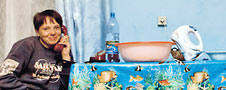
In 1887 at the place where, for most Europeans, their continent had long since ceased to exist, land surveyors of the Austro-Hungarian monarchy established Europe’s midpoint: in the Carpathian Mountains. Today, the mountain range is spread across five countries: Hungary, Poland, Romania, Slovakia and the Ukraine. The area where the Carpathians reach their highest point is home to the Hutsuls. I read the name for the first time in a dusty old secondhand bookshop in Hamburg. While leafing through a German publication called “Illustrierter Führer durch Galizien” (Illustrated Guide through Galicia) from 1914, a short passage on page 284 roused me from my drowsiness:
“One of the most original expressions of the Hutsu lian way of life is the open relations between the sexes. Almost all married Hutsul women have a lover and vice versa. For the Hutsuls, faithfulness in marriage is completely unfamiliar.”
That was ten years ago. Since then, I have been obsessed with page 284. A people who practice free love, in the heart of Europe! Two World Wars and 45 years of Soviet communism lay between the “Illustrated Travel Guide” and today. Do the Hutsuls even still exist?
I received my answer four years ago during the Eurovision Song Contest in Istanbul. “And the winner is ...”— Ruslana. Representing the Ukraine, according to the newspapers, was a Hutsul woman. So they did still exist! I made up my mind to set off on an expedition.
I searched through university libraries. But instead of finding evidence of Hutsulian freedom, I initially only encountered tight-laced librarians who slammed the dusty books I had ordered onto the table. One of the volumes was called: “Letters about current conditions in Galicia,” written by a Mr. Kratter after a journey there in 1786, in which he notes his disgust for the Hutsuls: A people with an “insatiable inclination towards excessive drunkeness.” At the markets in the area he came across “nothing but drunkards”. Which sounded to me very promising, indeed.
Then I read a 200-year-old report by a certain Samuel Bredetzky: “Beware the poor travelers who must spend a night under the same roof with these half-humans.” Everywhere he went he encountered “a lack of morals”. I felt warm all over.
Almost everyday the mailman delivered cardboard boxes filled with books. In the novel “The Carpathia Robbers” by the Galician author Leopold von Sacher-Masoch, a Hutsul woman says: “I don’t want to sell myself to a man like an animal, and be his when he wants me. I want to be free, I want to remain a wild cat.”
I traveled to Vienna. Completely alone in “Reading Room 8” of the National Library, I carefully leafed through the travel diaries of Professor Balthasar Hacquet from 1791. Was I chasing after a fantasy? The book basically talked about rock formations and mountain foliage — until, already dead tired, I happened upon page 18 of the third volume where Hacquet noted of the Hutsuls: “There are only a few who live with their wives, instead with one or more half-sisters or neighbors. Jealousy has no place here, all the more though the syphilitic scourge.” That did it. Let the journey begin!
The most comfortable way to journey to where the Hutsuls live seemed to me to be via Lviv, then continuing on from there with a rented car 300 kilometers into the mountains. I considered autumn to be the best time to make the trip: When the fruit trees are being harvested and the first schnapps already being distilled, both of which can’t be at all bad for lovemaking. In addition to a jumbo package of condoms, my suitcase contained 28 bottles of German herbal schnapps to help ease things with the Hutsuls.
“Always ten women at a time, or at least three, one for the bed, one for the spirit and the third for the heart — no, what am I saying. Leave the heart out of it, completely out of it, I tell you.” A pothole, two meters wide and a half a meter deep, tore me out of my Sacher-Masoch daydream. The tire was flat, the rim bent, and the axle warped. From the outset, I didn’t feel right in my cheap South Korean car. One shouldn’t travel in such an unworthy vehicle to meet such freedom-loving, mounted rustic folk whose means of transportation, namely horses, have the same name as their owners: Hutsuls. Small, tough animals, just right for the mountains.
I actually smelled my first real Hutsul before I saw him. He approached me from behind while I was in the village of Kossiv where, every morning at 6, the highlanders have always bought and still buy their apples, plums and Bryndza (a sheep’s milk cheese that takes some getting used to), all of which is spread out on rickety wooden tables. Juri, as he was called, had breath that was, well, breathtaking. As the vodka fog lifted, I saw an unshaven man with four gold teeth (the only teeth he had), who was holding under my nose a wooden box he had carved himself. As he was, apart from this, unarmed, I declined with thanks.
In the only tavern at the market, a windowless shack, I met up with him again a bit later. It was Juri who taught me my first Hutsulian word: “Lubaska.” This literally translates to “whom I love” and more specifically refers to a woman to whom one is not married.
Over a narrow mountain pass I arrived in the Valley of the Black Czermosz, a raging river that, every ten years or so, sweeps away bridges, streets and, sometimes, lubaskas as well. Dotting the slopes here and there were the low blue wooden houses of the Hutsuls. The farmers were in the midst of piling up dried grass into high haystacks. Standing atop the haystacks were mostly young women, who were stamping down the hay with their feet. I stopped at the nearest haystack. The two farmers threw down their rakes, and before I could pull out my Jägermeister schnapps, I felt a bottle vodka being shoved between my lips. After a bit of small talk about the weather and how schnapps is made, I got to the point. Love, lubaska, jealousy — how is it here actually?
Edita, my Ukranian translator, turned redder than the faces of the sunburned farmers. Both men looked up inquiringly at the haystack, where the women were looking back down at us, smiling.
We had already taken up our observation posts in a farmhouse. The name of the village was Verkhowyna, and a boastful sign on the way into the town called attention to itself as the “capital of the Hutsuls.” We discovered that a wedding was going to take place in the evening; a small wedding, supposedly, with only 200 guests and for two days. We, too, were invited. At 10 p.m. sharp we all met up with our flashlights in front of the farmhouse.
The mere thought of a Hutsul wedding had put me in an enraptured state of expectation. In Professor Hacquet’s book I had read just how this kind of wedding ends— and I was ready for everything. Back then, the most beautiful dancer was sent to Hacquet’s hut by the groom himself to spend the night. “Through this action,” Hacquet noted in his diary, “one can observe just how foreign jealousy is to them”. Just in case, I had applied a bit more aftershave.
Near the wooden cottage of the bride’s father, two large tents had been set up; one for eating and drinking, the other for dancing. Around 200 men in embroidered shirts and women in headscarves sat tightly packed and filled each other’s glasses with vodka. Up until midnight, I had seen no sign of the bride and groom. Only then did I notice that the two of them were sitting behind a decorated fir tree at the front of the tent and that they were hardly playing a role at their own party.
The tables groaned under the weight of dishes with sausages, stuffed cabbage, potato salad and vegetable-laden platters. A fiddler and accordion player were running up and down the rows of benches playing lubaska tunes.
Long after midnight, the dancing began: a dashing and whirling about. Couples locked in embrace, bumping into each other, fell to the floor, struggled back onto their feet and once again started spinning around until they dropped back onto their benches, dizzy and giddy. I spun around with them for a while and then stood conspicuously at the entrance to the tent, alone. And I remained alone. Almost all of the men wanted to drink a toast with me; however, I was waiting, seemingly in vain, for a very different kind of offer. As I said, in vain.
When the disappointment repeated itself on the second wedding day, I decided to visit the remote pastures of the Hutsul herdsmen, to see if “free love” was still a part of their lives. The higher regions of the Carpathians are best visited on horseback. The paths are not navigable for cars.
“Hojo,” I shouted into my horse’s ear, and he actually broke into a trot. As we scaled the mountain for hours on end, I cursed myself all the while. Who had convinced me to search for phantoms in this godforsaken region? At the summit of the Czarna Góra, the “black mountain,” there were traces of the first snowfall and dark clouds were approaching from the west. We sought shelter in a pine forest. Roman, our Hutsul guide, had forgotten his vodka — my time had come. I tempted him with my bottle of schnapps: “But only if you tell me the truth about lovemaking.” We sat down together on a tree stump and Roman began his story, which began as all pretty fairy tales do: Once upon a time. And it ended with: “If something like that still exists today, then only as a rare exception. Jealousy is as much a thing here as anywhere else”.
Silently, we rode back down into the valley. After a brief shower, the fall sun shone onto the dark woodlands, and white smoke was rising from the huts. A dream.
The writer Josef Wittlin must have foreseen the downfall of Hutsulian freedom. His novel “The Salt of the Earth” begins with the words: “Into the silent corners of Hutsulian terrain smelling of mint on summer evenings, into the enchanted villages that lie on still pastures where herdsmen play long wooden flutes, the railroad makes its way”.
That train departed long ago.
Text: Philipp Mausshardt, Photos: Kathrin Harms
Bilfinger Berger Magazine 1/2009


