



 Kennzahlen


 Bilfinger Berger Magazine 2/2009


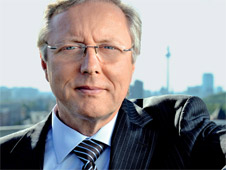
BILFINGER BERGER POWER SERVICES RELIES ON ITS OWN PEOPLE INSTEAD OF PURCHASING SERVICES FROM THIRD PARTIES. AN INTERVIEW WITH CHIEF EXECUTIVE GERD LESSER.
Mr. Lesser, I recently asked a group of friends what they associated with the name Bilfinger Berger. And do you know what their answers were? Tunnels, bridges and office blocks. Not one of them came up with power station technology. Does that bother you?
Our division is less well known to the general public because our name doesn’t appear on countless construction site signs dotted around city centers and motorways. Fact is, the services business is becoming increasingly important for Bilfinger Berger. And Power Services is the division generating the highest earnings.
People tend to think of “services” as relatively simple tasks that clients don’t want to bother with.
That is quite wrong. Of our 6,900 employees, 2,000 are engineers and a lot of them are technicians and skilled workers.
And what exactly do they do?
We work for coal- and oil-fired power stations and nuclear plants. We develop and manufacture coal pulverizers, combustion plants, boilers and the high-pressure pipes that carry steam to the turbines. We also supply systems that remove harmful substances from the exhaust gas. We bring old stations up to the latest standard to make them safer, more environmentally friendly and more economical.
Your company is growing despite the crisis in the global economy. How so?
Power plant operators know that they can rely on us 100 percent, simply because we produce and install almost everything ourselves. We also provide the engineering. We are familiar with the latest developments in power plant technology. And we are involved in a number of important research projects.
Would it not be more profitable to buy in specialized services rather than keeping everything in-house?
We can only be sure that our products are top quality and delivered on time if we do the vast majority of the work ourselves. That is worth a great deal to our clients, especially in times of crisis. Imagine a 1,000 megawatt power station. Every day that it is shut down represents a huge loss to the operator. We do everything we can to make sure the client can rely on us. On the other hand, that also means that we do not work for dumping prices.
Isn’t that a risky strategy?
No, it pays dividends. We have substantially increased our output and our results relative to 2008. With one small exception, the acquisition of an industrial installation company in Croatia, this has all been organic growth. In other words, growth we have achieved through our own efforts. And when it comes to high-pressure piping systems, we are number one in Europe.
What about markets outside of Europe?
There will be strong demand in South Africa for decades to come. Energy is in immensely short supply because economic developments were underestimated for a long time. Entire factories simply cannot be built because there is no electricity. And South Africa also opens a window for us into other African countries.
Almost all your South African managers are white. Is that in tune with the times?
First of all, besides a balanced employment structure, the South African government also specifies that a large proportion of the shareholders must also be black. In that respect we have come a long way. Our companies in South Africa are thirty percent black-owned.
Fine, but why don’t you have black managers?
Unfortunately there are still too few South Africans with the proper training, regardless of the color of their skin. The training and employment market simply cannot keep pace with the headlong development in the energy sector. That’s why we are now sending German staff to South Africa who will then gradually be replaced by local employees. To a large extent we are training these people ourselves. In welding and assembly work, we are the largest training provider in South Africa. And in high-pressure welding we are the only provider.
Are there other interesting markets abroad?
At the moment we are thinking mainly about Australia. We are talking to our colleagues at Bilfinger Berger Australia who have been in close contact with power plant operators for decades. We have agreed to contribute our expertise so that we can jointly generate new business. Russia and India are also attractive. Clearly, to minimize the risk we are only going to become active in countries we are familiar with, for example via local partners.
Do power plants abroad meet the same standards as those in Germany?
The Medupi and Kusile coal-fired plants that we are supplying in South Africa have a 44 to 45 percent rate of efficiency. That’s state-of-the-art. We are also currently trying to convince the South Africans to install flue gas purifiers. Desulphurization units are obligatory here, but that is not yet the case in South Africa.
Are coal-fired power plants at all compatible with climate protection?
Yes. Of course the energy balance has to be improved, because a lot of the measures to protect the environment are at the expense of efficiency. The challenge lies in finding materials that can withstand the increase in temperature and pressure that we need to achieve a greater level of efficiency. Carbon capture and geological storage techniques also offer attractive prospects. Incidentally, we built the flue gas purification system for the first CO2-free experimental power plant.
Resistance to large-scale power plants is rising in Germany. Would we perhaps be better off with remote heat and power plants serving local communities?
Life is a series of compromises. In future there will be a mixture. Localized energy systems are gaining ground and we are aiming to develop a product of our own: micro gas turbines in the order of around 250 kilowatts. These would be suitable for hospitals, schools or small factories. We intend to go into production in 2011. However, we are also involved in the field of nuclear fusion, for which we are developing sophisticated superconducting magnets. CERN is one of our partners.
What will the key energy source of the future be?
Gas is finite, coal too. And biomass does not grow as fast as our energy requirements. I think that in 100 years it won’t be wind or solar energy that is of central importance, but nuclear fusion. The idea involves replicating the processes that take place in the interior of the sun. And the sun itself is proof of millions of years of energy.
(Interview: Sara Mously, Photo: Eric Vazzoler)
Bilfinger Berger Magazine 2/2009


